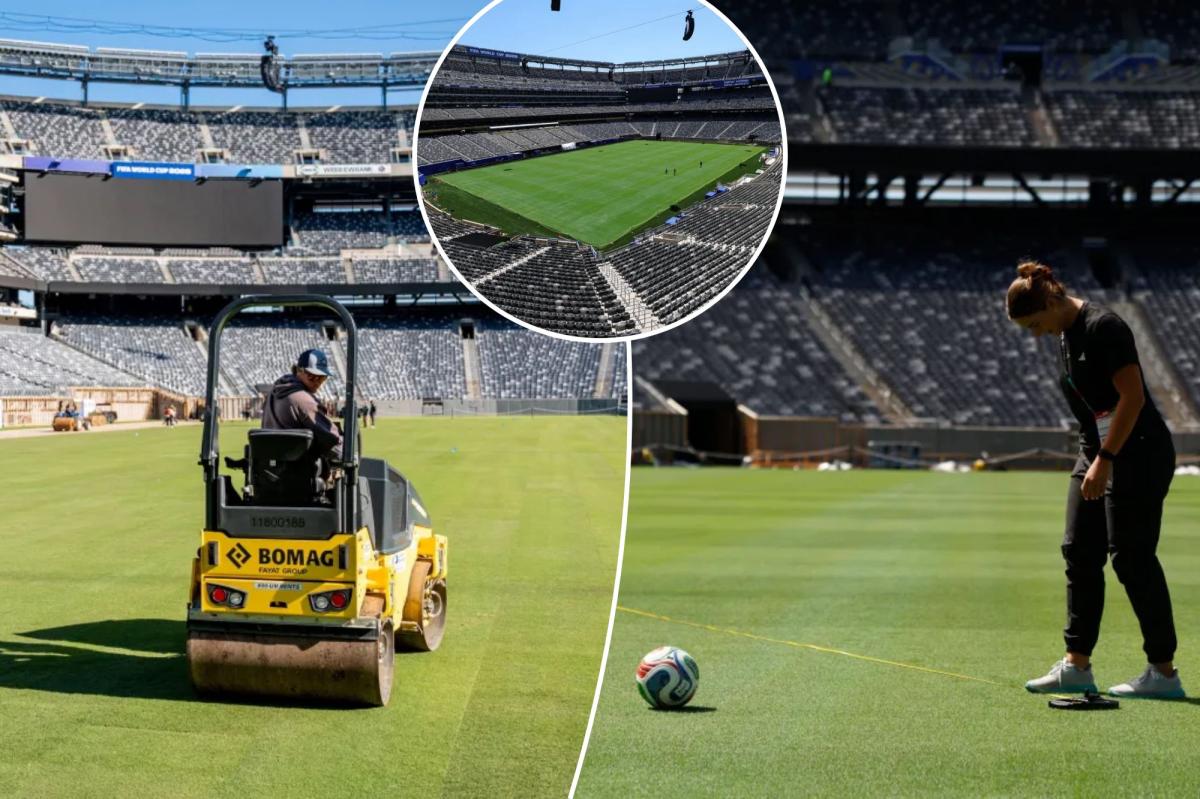
The world’s premier soccer gamers will grace the pitch at MetLife Stadium over the next few weeks at the 2026 FIFA World Cup. And the two finest groups will battle there for everlasting glory come July.
The finest approach to showcase their skills is with a pristine subject. For some venues, such as MetLife, that requires an complete facelift — including a grass floor on prime of synthetic turf to comply with laws established by FIFA, soccer’s governing physique.
“Soccer is for everyone, whether you’re the kid that went to an Ivy League school or you’re the person that grew up with nothing,” CBS Sports Golazo analyst Michael Lahoud said. “And part of making a beautiful spectacle is you have to have the right field. Because a good surface showcases good players.”
FIFA has labored behind the scenes to guarantee the enjoying surfaces are sustainable all through the six-week event hosted across North America — which Lahoud believes is the naked minimal. Dr. Trey Rogers, a Michigan State University professor who helped develop the World Cup pitches, joked that if nobody writes about the subject situations, he’s completed his job.
A closeup view of the grass subject at MetLife Stadium for the 2026 World Cup. AFP via Getty Images
Over the previous six years, FIFA has partnered with researchers at the University of Tennessee and Michigan State to develop grass fields for eight World Cup stadiums that usually use turf, including MetLife. The new pitch was put in at MetLife on May 7, in time for the venue’s first of eight World Cup matches on June 13 between Brazil and Morocco.
Before the grass sees its first motion, The Post talked to these concerned with the mission and quite a few soccer consultants about the course of behind creating MetLife’s pitch.
“When it comes to delivering a field for the World Cup, to have those numbers, have all that thought process, it’s been very beneficial, and I couldn’t do my job without any of that information,” David Graham, FIFA’s senior pitch supervisor, advised The Post about its work with MSU and UT.
The course of for creating that subject began a decade in the past. Graham said FIFA’s conversations about the 2026 event started in 2016. Tennessee was tabbed to assist in 2018, and Michigan State joined in 2020. They were chosen because of the work Rogers and Tennessee’s Dr. John Sorochan put in on the Pontiac Silverdome’s subject for the 1994 World Cup.
So, Rogers, Sorochan and Co. started analysis to create one uniform subject across the venues with turf, such as MetLife.
They first wanted to determine what to do with MetLife’s turf, Rogers said. Do you take it out? Put something over it besides sod?
They selected to lay a mat called permavoid on prime of asphalt for simpler water drainage, per Rogers, and stitched artificial fibers into the grass’ underbelly to reinforce its roots, American soccer analyst Devon Kerr added.
FIFA examined the prototype utilizing the foot decrease extremities (fLEX) machine, which simulates how the subject reacts to a player’s foot strike. Sorochan said that helped guarantee the floor’s security.
“Not only can we test the playability of a natural surface, (we) can also start to measure the loads being felt by the athlete as they hit that surface,” Sorochan said.
University of Tennessee graduate analysis assistant Conlan Burbrink inspects turfgrass rising inside the college’s East Tennessee AgResearch and Education Center. Steven Bridges/University of Tennessee
Michigan State, Tennessee and FIFA also collaborated at 4 Pitch Management Field Days across the previous two years. There, Rogers said they held seminars to present analysis updates, pitch concepts and set future plans. The first assembly in May 2024 saw over 250 folks, including turf specialists and FIFA representatives, collect at Tennessee.
The analysis helped them select two differing types of grass for the fields — a Kentucky bluegrass and ryegrass combine for the 11 stadiums in cool environments and hybrid bermudagrass for the 5 in heat seasons — MetLife, Hard Rock Stadium (Miami, Florida), Levi’s Stadium (Santa Clara, California), Estadio BBVA (Monterrey, Mexico) and Estadio Akron (Guadalajara, Mexico). Graham added that rising the bermudagrass took more than eight months.
“Because that was such a large project, you had to divide it up into segments. Get comfortable and then start adding to it,” Rogers said of the Field Days’ affect. “It’s like building something out of tinker toys.”
That work is essential because of grass’ advantages over turf.
Injuries are more prevalent on turf — particularly at MetLife. NFL stars Malik Nabers, Aaron Rodgers, Nick Bosa and more suffered season-ending accidents on MetLife’s turf in latest years.
David Copeland Smith, a coach who’s labored with World Cup gamers, has seen it many occasions — one fallacious step on turf, and “say goodbye to your ACL.” So, his gamers usually wouldn’t go 100% on turf. One mentee, former USWNT defender Kelley O’Hara, refused to prepare on turf because she couldn’t observe at full velocity and had a longer restoration course of.
Dr. Nicola Maffulli, a famend orthopedic surgeon, also advised The Post that grass is much more forgiving. Turf usually leads to more Achilles and patellar tendon tears and separate accidents precipitated by continued pressure on athletes’ legs.
An complete World Cup on turf would lead to “massive cumulative fatigue,” Copeland Smith added.
Soccer subject situation exams are carried out on the grass subject at MetLife Stadium on May 28, 2026. John Angelillo/UPI/Shutterstock
“I would rather play on an all-natural surface that’s banged up a little bit than a perfect turf pitch that looks beautiful to the eye because to me, there are underlying issues that will arise over the years,” said Kerr, whose enjoying profession ended prematurely after two meniscus tears precipitated by coaching on turf.
Hence why FIFA requires grass for the World Cup.
“I want those players to step onto that field and just completely trust it,” Copeland Smith added. “My hope is that the pitch supports the spectacle, not competes with it.”
An early iteration of MetLife’s new grass pitch was showcased at last summer time’s Club World Cup. But it was a catastrophe.
The video games trudged alongside at a snail’s tempo as gamers adjusted to softer and shorter grass. Borussia Dortmund supervisor Niko Kovač in contrast it to a placing inexperienced while expressing concern about MetLife’s watering system.
Players also complained that the pitch was “tough on the knees,” because softer grass usually causes instability.
Lahoud said he felt the subject preparation — including the grass on prime of MetLife’s turf — was rushed.
“I think it was kind of a throwaway. It’s more about enticing the teams to come than it is about the quality of the grass,” Lahoud said.
The grass subject is put in at MetLife Stadium. REUTERS
Tennessee, Michigan State and FIFA had one last probability to make tweaks to the pitch at the remaining Field Day in February, the first assembly since the Club World Cup.
Rogers said he wasn’t stunned by these outcomes because many of the stadiums, such as MetLife, didn’t have ample time to put together the fields. Still, Kerr thinks the Club World Cup was completely timed to present any points.
February’s Field Day featured every subject supervisor plus many of the same FIFA executives and researchers current at the earlier gatherings. Through more testing, the group made changes to variables such as the development lights to further enhance the subject, Rogers said.
“We are guided by the research, which gives us the tools to move forward, to put the infrastructure in place to make it what you see here today,” Graham said.
That analysis has fueled every side of MetLife’s World Cup pitch.
Sorochan’s hope — and perception — is that the subject not only holds up across its 37 days in motion, but that folks won’t even discover a distinction between Game 1 and the remaining on July 19.
In that case, Rogers would get his want, too. The subject wouldn’t be the story, the final irony after years of work.
“A lot of great field managers, and a lot of blood, sweat and tears have gone into these pitches, and I think it’s going to be showcased for this World Cup,” Sorochan said.
Source hyperlink