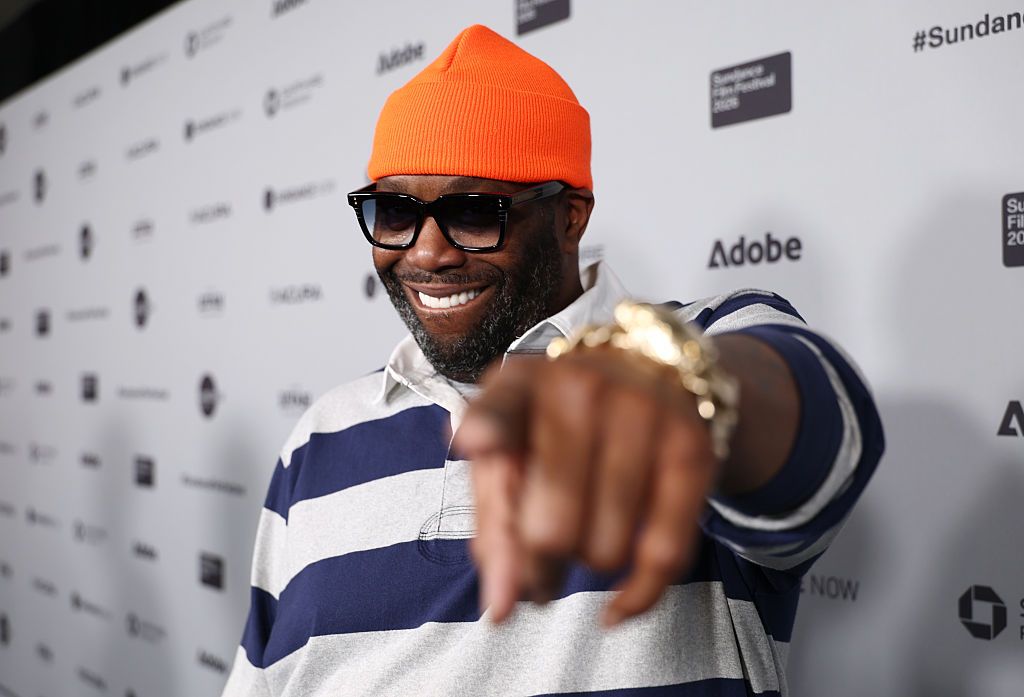
Source: Cindy Ord / Getty
Trying to figure out Killer Mike is exhausting. Not because the man is particularly complicated, but because he seems determined to make being a Black capitalist with a revolutionary marketing strategy everybody else’s problem.
One minute, he’s talking about Black liberation. Next, he’s doing an NRA commercial, interviewing Herschel Walker and Brian Kemp, and positioning himself as the kind of independent thinker who apparently believes the best way to fight oppression is to make friends with the people who benefit from it. It’s confusing because Killer Mike is giving off in-the-house vibes while trying to act like he’s off the plantation.
Never forget that Killer Mike didn’t just cozy up to Kemp; he chose to platform the political magician who made Black votes disappear, but he was literally running against Stacey Abrams, who would’ve become the first Black female governor of Georgia had she won.
And whenever somebody questions the contradictions, Mike seems to have the same response: You must be broke.
At this point, Killer Mike needs to change his name to “Karen Mike” because lately, he’s been doing a whole lot more complaining, demanding to speak to the manager, and giving conservative politics a platform than killing anything. Certainly not the status quo. That thing seems perfectly comfortable around him.
His latest interview with Vic Mensa only adds to the frustration. The conversation, released Oct. 14 on The Vic Mensa Show, took place inside Fred Hampton’s childhood home. Yes, THAT Fred Hampton, the Black Panther Party leader who was assassinated by police in 1969. The symbolism practically writes its own jokes.
The two discussed Black liberation, political organizing, Cop City, and Mike’s relationship with Kemp. They also addressed the “move like a capitalist” line that has turned Mike into a meme. Mike pushed back on the characterization, saying he never claimed to be a capitalist, while defending his approach to engaging political leaders he disagrees with.
That is an interesting argument to make inside the childhood home of a revolutionary who was murdered by the state. And the funniest part, and possibly the saddest, is that Killer Mike doesn’t get it. He doesn’t get the jokes, the memes, or the irony. He doesn’t get that, in his complacent thinking, he’s not radical. He doesn’t realize that, at some point, his Timberlands turned into tap shoes, and he just can’t stop dancing.
Mike’s defense is essentially that being in the room with powerful people gives him an opportunity to get things done. But Mike doesn’t seem to understand that not all money is good money, and not all rooms are good rooms.
He’s currently proposing a grassroots funding model in which a million people contribute $10 a month to support movement infrastructure, beginning with efforts to preserve Hampton’s home. Fine. Community funding is a legitimate organizing strategy. Preserving Black history is important. And talking to politicians you disagree with is not inherently a betrayal.
But being in the room isn’t the same as changing the room. And constantly telling people you’re playing some sophisticated political game doesn’t mean the rest of us have to applaud every move you make. Mike believes he’s playing 4D chess when he’s actually just playing cookout checkers.
Mike’s defenders will say he is a businessman who understands how power works. Yet his history of political engagement includes an NRA interview that drew widespread criticism after the organization used his comments to promote its agenda. Mike later apologized for the timing and how his words were used, yet he still doesn’t see that he’s playing a dangerous game and always on the wrong side of the race war.
His interviews with Kemp and Walker, Republicans whose political agendas deserve scrutiny from anyone claiming to champion Black interests, were choices, not accidents. At a crucial moment during the Black Lives Matter movement and during Trump’s first term in office, Mike was out here kicking it with the opps of Black people.
Which is fine. For every Fresh Prince there is always a Carlton.
The problem emerges when somebody sells himself as a champion of Black liberation while repeatedly lending his credibility to politicians and institutions whose agendas conflict with the interests of many Black Americans.
And when criticism comes, the conversation too often turns into a referendum on the critic’s bank account.
Apparently, if you don’t have Mike’s money, you don’t get to question his judgment.
That’s a convenient argument from somebody who has spent years telling Black people to educate themselves about power, economics, and the ways wealthy people manipulate the system. If you believe engaging conservative politicians is the best way to advance Black interests, make the case. Explain what you accomplished. Tell us what changed for Black people because you were in the room.
But don’t act as if the people asking questions are merely jealous because they don’t have a successful business. The man can be rich and wrong at the same time. These things are not mutually exclusive.
The contradictions sting because Mike is talented and politically engaged enough to know better. Run the Jewels built its reputation on music that challenged entrenched power, confronted racism, and encouraged listeners to question the people running the show. Mike’s solo work and public commentary have often carried that same energy.
Which makes the conservative photo ops and the lectures to his critics feel like watching somebody slowly become the manager he once rapped about fighting.
The latest Vic Mensa interview also reveals the problem with Mike’s insistence that people misunderstand him. Let me make this abundantly clear: We don’t misunderstand Killer Mike; we just can’t believe him. We can’t believe he has the audacity to act like some truth-teller whose harsh realism is too difficult to digest. Nah, Fam. We know exactly who you are, and we are disgusted by it.
Mike can explain his intentions all day, but intentions don’t erase the consequences of political choices. And when the criticism is coming from people who share his stated concerns about Black liberation, dismissing them as broke or confused is not a substitute for answering their arguments.
At some point, the audience can stop doing public relations for the artist.
Mike’s wealth, conservative connections, and proximity to power are not some magical force field against racism. White supremacy has never promised to spare Black people just because they have money or know the right people. Killer Mike is free to be a capitalist, even if he rejects the label. He’s free to interview Republicans, defend his strategy, and build his business empire. But the rest of us can notice when revolutionary talk starts sounding like an advertisement for the ruling class.
So maybe it’s time to retire Killer Mike and make room for Karen Mike: the guy who wants to speak to the manager, complain about the haters, and remind everybody how much money he has.
Because right now, the only thing he’s consistently killing is the patience of the people who once believed he had something important to say about Black liberation.
SEE ALSO:
The NBA Has A Black Father Problem. The Problem Isn’t Black Fathers
Kelly Clarkson’s Fake Bird Fiasco Is The Whitest Thing On The Internet