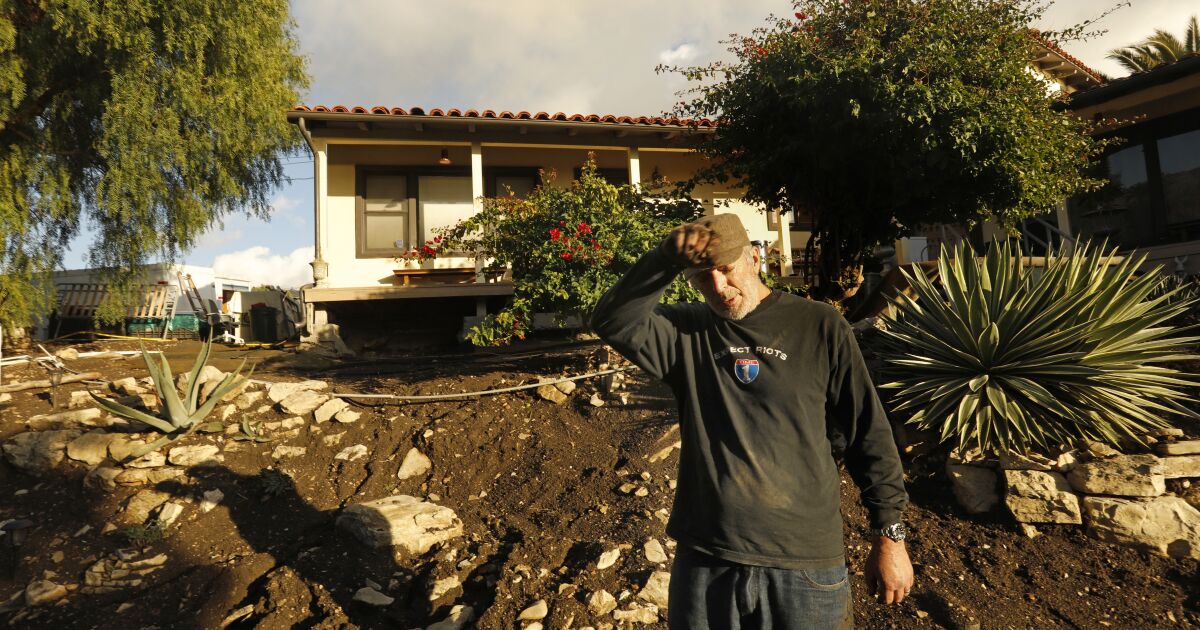
A landslide struck Laguna Seashore’s Bluebird Canyon in 1978 — smashing automobiles, buckling streets and destroying 24 properties. An adjoining swath of earth broke unfastened in 2005, wiping out 12 extra properties.
That wasn’t sufficient to maintain Scott Tenney away. In 2010, Tenney and his spouse, Mariella Simon, purchased a 15-acre hillside ranch close to the catastrophe space regardless of the itemizing warning that the property was on the positioning of an historical landslide.
“We knew we’d have to do a bit of terracing and retaining, but California is what it is,” Tenney mentioned. “It’s a dynamic place not just culturally, but geologically.”
From an outdoor perspective, his may appear a confounding determination. However in Southern California it’s a particularly widespread one, as a result of that geological range, as Tenney calls it, isn’t just the hazard. It’s the attract.
Elevation has lengthy been aspirational right here — an escape from the city flats.
Since settlers first began pouring in from the relative flatness of the East Coast and Midwest, they had been captivated by California’s vertiginous panorama. Plein air painters flocked to seize the sunshine of the arroyos. Well being seekers sought the clear air of the San Gabriel foothills. People rockers discovered inspiration in Laurel and Topanga canyons. And the moneyed elite began constructing their homes increased and better above the basin, endlessly looking for the trophy perch with the show-off view.
However that perch has at all times come on the threat of disaster. Houses slide right into a gulch in Palos Verdes. Fires roar over the Malibu hills. A particles move kills 23 folks and destroys 130 properties in Montecito. Heavy snow traps hundreds within the San Bernardino Mountains. And winter storms pull fragile bluffs right into a rising sea.
These pure disasters so usually happen the place the tectonic plates collided and folded into stunning vistas.
Whereas different areas might face just one most important catastrophe menace — tornadoes within the Midwest, hurricanes on the Gulf and East coasts — California’s excessive topography brings siege from all sides: the ocean, the timber and brush, the sky above and the bottom under. And oftentimes, essentially the most enticing areas are a number of the most harmful.
A land of disasters
Increasingly persons are crowding into the Wildland City Interface — the zone of transition between unoccupied land and human improvement. It’s the place properties mingle with undeveloped (and infrequently steep) land, and it’s uniquely inclined to pure disasters.
In response to the U.S. Hearth Administration, this space grows by 2 million acres a yr as folks fan out to the sides of wilderness looking for inexpensive homes, extra space or just a break from life within the metropolis. And California holds extra properties on this harmful zone than another state within the nation.
And costs hold hovering. It doesn’t matter if a home sits on stilts on the aspect of a cliff, if it’s a landslide advanced slowly sliding towards the ocean, or if it’s predicted to be knee-deep in water in a few generations — there’ll at all times be a purchaser.
As Californians flock to dangerous areas, disasters take a better toll. During the last decade, the state has skilled 20 disasters that every price not less than $1 billion in harm from flooding, wildfire and excessive warmth. These 20 alone mixed for 783 deaths, in response to Nationwide Facilities for Environmental Info.
In response to the actual property itemizing database Redfin, the development is nationwide. Final yr, the nation’s most flood-prone, heat-prone and fire-prone counties all noticed extra folks transfer in than out. Redfin researcher Sheharyar Bokhari blames one main issue: the housing affordability disaster.
“L.A. and most other coastal cities are expensive. With remote work becoming more of an option, people are finding they can have more space and finally afford a home if they move to riskier areas,” he mentioned.
Bokhari mentioned one other L.A.-specific issue is improvement — primarily that there’s not as a lot being constructed within the metropolis in comparison with the extra rural areas surrounding it.
He factors to the Inland Empire, which is often extra inexpensive than L.A. County. In Riverside County, roughly 600,000 properties face a excessive threat of wildfire, essentially the most of any of the 306 high-fire-risk counties within the nation. Regardless of that, the county’s inhabitants grew by 40,000 over the past two years.
Even when specialists — and customary sense — say to avoid sure areas, Bokhari mentioned that received’t seemingly occur as a result of native governments aren’t incentivized to push folks out.
“These disaster-prone cities need revenue and people paying taxes,” he mentioned. “They just claim that they’ll be more resilient and take more safety measures going forward,” he mentioned.
The place else would I am going?
Since transferring onto the traditional landslide zone, Tenney and his spouse based Bluebird Canyon Farms, which affords workshops and grows meals for native markets. His time is break up between that and taming the erosion-prone land beneath the farm.
To fight sliding land, Tenney put in a gravity wall, 200 toes lengthy and 9 toes tall, to retain the hillside. Along with grading the terrain to make the slopes gentler, he added highly effective drainage programs and timber-and-concrete cribbing to maintain buildings in place.
The work by no means stops, and Tenney retains a month-to-month schedule to maintain up with duties. Clear brush in spring. Clear storm drains in September. Examine terracing each few months.
“You can run but you can’t hide,” he mentioned, including that city facilities similar to L.A. have their very own laundry lists of issues to fret about: crime, homelessness, and many others. “You won’t experience a wildfire in downtown L.A., but there are plenty of other things to be concerned with.”
Cribbing programs utilized by Tenney have develop into commonplace in Portuguese Bend, a small coastal group on the Palos Verdes Peninsula located on a slow-moving landslide advanced. Land strikes as much as 8 toes a yr, and at that charge residents would relatively journey the sliding earth towards the ocean than promote and transfer elsewhere.
“I’ll be here until I can’t be here anymore. I’ll slide away with the land,” Claudia Gutierrez instructed The Instances in July after a close-by landslide in Rolling Hills Estates despatched a handful of properties careening down a canyon.
Peter James Cavanna, a resident of the non-public group of Portuguese Bend, is coping with the shifting basis of his home. He intends to remain.
(Carolyn Cole / Los Angeles Instances)
You’d assume the actual property market in disaster-prone areas would finally decelerate, however there aren’t any offers to be discovered for home hunters. Longtime residents usually keep put post-disaster, and incoming residents persistently pay a premium to stay in a scenic, although probably harmful, space.
In cities tucked among the many foothills of the Verdugo and San Gabriel mountains similar to Altadena and La Cañada Flintridge, shopping for in a high-fire-risk zone could be ever-so-slightly cheaper than shopping for in a safer place. And consumers pounce.
“My clients try to choose low-fire-risk zones, but if the house in the fire zone is the right price, that is more important,” mentioned Brent Chang of Compass.
When Lisa and Michael McKean obtained home to Malibu Park from their honeymoon on Nov. 8, 2018, they had been so exhausted that they went straight to sleep. The newlyweds didn’t even hassle unpacking their suitcases of swimsuits nonetheless moist with Caribbean saltwater.
When they awakened, Lisa regarded out her again window and noticed a ten,000-foot cloud of billowing black smoke.
The Woolsey fireplace was ravaging the Malibu hills.
The pair grabbed their still-packed suitcases and fled to the Zuma Seashore parking zone, the place they spent the day surrounded by horses, canine, cats and neighbors all questioning if their properties would survive.
Theirs, constructed a yr earlier, didn’t.
“The entire neighborhood burned,” Lisa mentioned. “Everything was black, scorched earth.”

Michael and Lisa McKean’s Malibu home burning through the Woolsey fireplace in 2018.
(Lisa McKean)
Devastated, the pair spent six months crunching numbers on the price of rebuilding versus transferring. The home that was destroyed had taken 4 years to approve and three years to construct. Their subsequent one might take even longer.
Regardless of the harm, and regardless of the ceaseless, inescapable threat of a future fireplace, they finally determined to remain and rebuild.
Cheryl Calvert has lived in Malibu since 1985 and has tailored to a lifetime of fireplace. To her, the flames are almost routine.
“Once you make it through your first one, you realize it’s manageable. But you have to plan ahead,” Calvert mentioned.
She retains two luggage packed always: one stuffed with goggles and N95 masks and one with canine provides.
Calvert has skilled loads of fires throughout her time within the coastal group, however the worst was the Corral fireplace in 2007. She was within the driveway because the flames arrived, and she sprayed the nook of her picket home with a hose because it ignited. Her guesthouse and storage burned down, however the home was saved.
She by no means thought-about leaving. As a substitute, she turned extra ready, putting in an additional water tank and leaving a pair of sneakers by the entrance door always for fast escapes.
“We have to do crazy things, but it’s only crazy for an hour or two every five or 10 years,” she mentioned.
She ran down the same old checklist of the reason why folks transfer to Malibu: the attractive panorama, the ocean breeze, the sweeping views. However she mentioned the primary motive her and so lots of her neighbors keep is due to the group.
“We’re all living near like-minded people who are willing to risk themselves for each other,” she mentioned. “It’s a bunch of hippies. Rich hippies.”
The psychology of staying
A life among the many timber, coasts and cliffs is commonly what lures Californians to disaster-prone communities, however in response to specialists, the elements that make them keep after a catastrophe strikes are rather more difficult.
Age, race and sophistication can all point out whether or not somebody is kind of prone to transfer after experiencing a catastrophe. For instance, Zhen Cong, professor of environmental well being sciences on the College of Alabama at Birmingham, discovered that within the wake of tornados, the center class could be essentially the most inclined to maneuver for the reason that higher class has the sources to remain and rebuild, whereas the decrease class is commonly trapped and has no different alternative however to remain.
Different relocation elements embrace the extent of injury to the home and whether or not the particular person owns the place or rents. However usually an important issue is one that may’t be simply quantified: “People who have a strong sense of place and a strong sense of community are less likely to move,” Cong mentioned.
Paradoxically, some disasters may even encourage individuals who in any other case would have left to remain.
In finding out post-tornado relocation selections throughout the nation, Cong discovered that after a catastrophe, folks enhance their catastrophe preparedness. A part of that contains gathering provides, nevertheless it additionally contains social engagement: speaking to neighbors, sharing data on social media and attending conferences. That engagement, which could not occur if a twister doesn’t strike, brings a better sense of group, main folks to remain in that group.
Anamaria Bukvic, an assistant professor at Virginia Tech who research coastal hazards and inhabitants displacement, discovered that after Hurricane Sandy struck the East Coast in 2012, non-geophysical elements mattered essentially the most in deciding whether or not to remain or depart. For instance, confidence in adapting to future disasters was a extra related indicator if somebody would keep than how shut they lived to the ocean.
“The experience of flooding can be emotionally disturbing and traumatic,” Bukvic mentioned. “When facing problems, some people try to avoid them. Others try to resolve them.”
She added that confidence in authorities performs a serious function as effectively. If an individual believes the federal government responded effectively to the catastrophe and can hold them secure through the subsequent catastrophe, they’re extra prone to keep.
That’s one thing that Malibu Mayor Bruce Silverstein thinks about when overseeing town’s catastrophe response plan. Though L.A. County is accountable for bodily combating the fires that plague the realm, Malibu has instituted a free service by which residents can request a fire-hardening skilled to examine their property to higher put together them for the following blaze.
Town additionally outlaws sure varieties of vegetation inclined to fireside and tries to stop extreme inhabitants progress with a view to make evacuation from hills and canyons simpler throughout emergencies. It’s the primary motive accent dwelling models (ADUs) are tougher to construct in Malibu than L.A.
“Unlike L.A., we don’t have standards that encourage growth,” Silverstein mentioned. “We maintain the status quo and try to keep space between properties so if one catches on fire, it doesn’t extend to the neighbors.”

A hearth crew walks by a discipline charred within the Agua fireplace in north Los Angeles County on July 26, 2023. The blaze burned greater than 400 acres in Angeles Nationwide Forest.
(Myung J. Chun / Los Angeles Instances)
Michael Dyer, a former Santa Barbara County fireplace chief who now serves as public security director for Calabasas, mentioned security turned a prime precedence for town after Woolsey, energizing the group into forming a number of volunteer commissions that plan for catastrophe preparedness.
“We have to provide that service as a government,” Dyer mentioned whereas monitoring a brush fireplace in Topanga from his entrance porch. “No one has forgotten Woolsey yet. And as long as I’m here, we won’t.”
No easy repair
Because the local weather disaster worsens and the Wildland City Interface grows in dimension, specialists are eyeing methods to mitigate the results of pure disasters to save lots of each the setting and human lives.
L.A. is presently contemplating an ordinance that will restrict improvement within the Santa Monica Mountains. Utilizing latest wildfires and the Rolling Hills Estates landslide as examples, supporters mentioned the measure would make it tougher to construct mansions and huge hillside properties as a method to restrict harm brought on by disasters, in addition to defend open area and wildlife.
As well as, nationwide insurers similar to State Farm and Allstate are not promoting insurance coverage insurance policies in wildfire-prone areas after a sequence of catastrophic fires raised premiums. With out insurance coverage, folks could be disincentivized from shopping for and constructing properties in dangerous areas.
Redfin can be tinkering with a method to warn folks of a home’s potential risks. The corporate performed an experiment by which it confirmed an inventory’s flood threat rating to sure customers however not others and located that those that had been proven the scores had been much less prone to bid on the home.
The scores have since expanded to point out threat for fireplace, warmth, drought and storms.
Within the meantime, Californians proceed to construct, and rebuild, in disaster-prone areas. Lisa and Michael McKean, whose home burned down in 2018, moved again into Malibu Park in 2021.
As neighbors slowly filter again into the neighborhood, they stroll round to measure progress and congratulate those that have returned.
“We used to hate cement trucks and jackhammers, but now we celebrate them,” Michael mentioned. “The cheery sound of construction.”
Supply hyperlink