They’re showing less-than-great judgment in the great outdoors.
TikTok is turning treacherous alpine trails into bucket list destinations—and overwhelmed rescuers in New York and beyond are sick of rescuing these cocky, inexperienced adventurers.
Seduced by stunning summit videos that downplay the dangers of extreme hiking, these wannabe Daniel Boones turn into babes in the woods, stranding themselves on steep mountain trails or getting lost on unmarked trails in search of the perfect selfie.
The unpreparedness epidemic seemingly peaked last month when two 20-year-old Michigan hikers attempting Mount Marcy, the Empire State’s highest point, were trapped overnight without warm clothes, food, or headlamps. Rescuers found them the next day at 5:30 a.m.
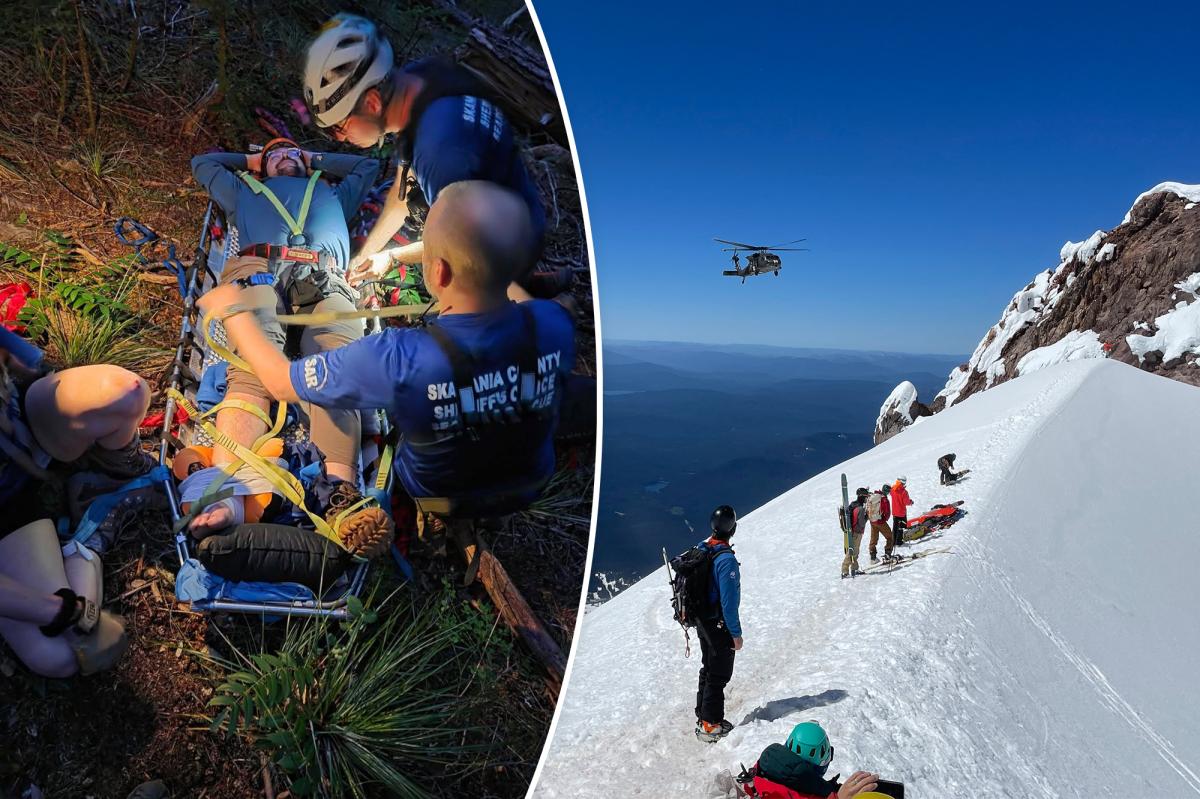
Members of the Hood River Crag Rats rescue an injured climber at 10,000 feet. Christopher Van Tilburg
Meanwhile, in August, four New Jersey teens required an overnight rescue from New Hampshire’s notoriously rugged Franconia Ridge after embarking on a grueling 7- to 9-hour hike at 3:30 p.m. sans proper supplies. Due to their negligence, officials said the hikers would have to foot their own rescue bill, which could range from $1,000 to $20,000 depending on the cost, according to the Boston Globe.
That same month, three novice hikers were stranded on California’s 14,179-foot Mount Shasta after using Gemini AI and YouTube to plan their path. They reportedly missed the recommended turnaround time and descended in darkness.
“People are completely clueless on the hazards of the area and then, therefore, are not prepared for it,” New York State Forest Ranger Robert Dawson, who’s based in Greene County, told the Post. “Then it leads into the ultimate situation where they’re now calling 911.”
The source of many non-preppers’ overconfidence isn’t exactly a mystery.
“Picture taking is the most dangerous recreational activity these days,” said New York Forest Ranger Robert Dawson.
Dr. Christopher Van Tilburg, a physician and volunteer for Oregon’s Hood River Crag Rats—the country’s oldest all-volunteer search and rescue team—recalled saving a family who planned their entire excursion via TikTok.
“They took a longer trail than was necessary, a more difficult trail in the middle of the heat of the day, underestimated the distance, underestimated their water needs, and got into trouble,” he told the Post matter-of-factly. “We had to go rescue them. So that’s fairly common.”
Rescue numbers are climbing
Rescuers with the Skamania County Sheriff’s Office tend to a hiker. Courtesy of Skamania County Sheriff’s Offic
Van Tilburg said that his 40-person team went from handling around 10 search and rescue missions before 2013 to roughly 50 to 60 in recent years amid a surge in hiking that began during the pandemic.
Meanwhile, New York State Forest Rangers conducted 366 operations in 2025, compared to low double digits in the early 2000s, per Dawson, a 20-year veteran.
“Getting into this year, we’re doing more than that,” lamented the beleaguered savior.
But don’t just blame Gen Z for wanting a good ‘gram post.
Eighteen- to 24-year-olds accounted for 18% of the incidents reported by participating rescue units across North America last year, according to Mountain Rescue Association (MRA) data cited by CNN. That means 82% of rescue calls came from people over 30.
Not out of the woods
Kaaterskill Falls in the Catskill Mountains in October, 2010. dianarobinson – stock.adobe.com
When the unprepared go hiking, they could face consequences like heat illness, hypothermia, injury, or disorientation.
“They try to find their way by bushwhacking or taking a shortcut and they lose the trail and they just get lost,” sighed Van Tilburg, who chronicled the Crag Rats’ gripping missions in his book Crisis on Mount Hood: Stories from 100 Years of Mountain Rescue.
Christopher Van Tilburg, a veteran rescuer with the the Hood River Crag Rats in Oregon. Daniel O’Neil
Dawson said that some winter visitors to the Eastern Catskills’ picturesque Kaaterskill Falls will approach the 260-foot frozen cascade in sneakers and cotton socks—then slide down the icy slopes into a creek, or even off a ledge, like a human luge.
“A rescue like that’s going to take a couple hours,” he said. “It’s going to take us 40 minutes just to get in there and then start doing patient care with you because we can’t just roll an ambulance up.”
For many amateur adventurers, these obstacles aren’t just physical.
Summer Scheyer, Sheriff of Skamania County in Washington State, claimed that they received three different rescue requests in 2025 for able-bodied hikers suffering from “panic attacks.”
Who rescues the rescuer?
A Crag Rats mountain rescue team rescues an injured hiker on Eagle Creek Trail in the Columbia River Gorge National Scenic Area in 2023. Christopher Van Tilburg
Along with wasting valuable resources, backcountry blunders can jeopardize the lives of the responders themselves.
Scheyer recalled a 2025 incident on Table Mountain involving a group of young men hiking through snow and rain. One attempted to scale the 3,500-foot peak despite doctor’s advice to avoid climbing above 1,500 feet because of a serious lung injury.
A partially submerged car is inspected by rescuers with the Skamania County Sheriff’s Office in Washington State. Courtesy of Skamania County Sheriff’s Offic
During the extraction, two searchers came “dangerously close to hypothermia” while inclement weather hindered aircraft assistance.
“This was an abhorrent waste of resources and a grossly dangerous mission that did not have to exist,” said Scheyer.
“We’re at risk every time we go on a mission,” added Van Tilburg, citing hazards from avalanches to nocturnal storms.
Between a TikTok and a hard place
The stunning Delta Lake in Grand Teton National Park, Wyoming. AlyssaKPhotography18 – stock.adobe.com
The spike in outdoor retrievals coincides with an explosion of outdoor content.
Tags like “hiking” and “hiking adventures” amassed 110 million and 11.8 million views on Instagram and TikTok respectively, according to CNN.
Like AI nature accounts that anthropomorphize unpredictable critters, many of these outdoor channels are blamed for giving hikers unrealistic expectations of the wilderness.
In a June column, Grand Canyon educator Marjorie “Slim” Woodruff chastised creators for portraying the strenuous, 20-plus-mile Rim-to-Rim hike through scorching heat like a walk in the (national) park.
The Lake of the Clouds hut is seen in the foreground of Mount Monroe from Crawford Path en route to the summit of Mount Washington, on Tuesday, Feb. 27, 2024. Boston Globe via Getty Images
Van Tilburg agrees with her. “People who post on social media don’t give an accurate description,” he lamented. “People who don’t have any business with the skill level of the hike that they are going on are doing it because they see it on social media.”
Often, the quest for the perfect selfie can prove more perilous than the hike itself.
“Picture taking is the most dangerous recreational activity these days,” said Dawson, referencing the rash of content creators falling off cliffs while posing for photos.
Don’t go chasing waterfalls
Rangers conduct a rescue at Kaaterskill Falls in July, 2022. NYSDEC
To avoid becoming an outdoor cautionary tale, experts urge people to treat TikTok videos as an inspiration, not an instruction manual.
“Objective information on social media is probably the most important thing,” said Van Tilburg. “If somebody says the hike is five miles, that’s better information than somebody who says the hike was pretty short and easy, because short and easy to one person is not short and easy to another.”
Rescuers carry a patient who suffered a diabetic emergency to a trailhead at Kaaterskill Falls, Sunday, July 12, 2026. NYSDEC
“I tell people to corroborate that with information from guidebooks, from climbing rangers, from friends who have done the hike or whatever, because taking social media as your sole source of information is very problematic.”
No matter what online wilderness warriors say, no hiker should go out without essentials, including extra food, water, clothing, and even portable shelters in the event of a stranding.
“Have enough stuff in your backpack that you can spend the night out if you need to,” said Van Tilburg, also recommending fully charged phones and navigation apps like AllTrails.
Just be sure to download the maps in advance for poor reception areas, he advised.
Above all, hikers must resist the urge to forge ahead when conditions deteriorate, as no summit selfie is worth the risk.
“This isn’t Mount Everest,” said Dawson. “You can always come back.”
Source link