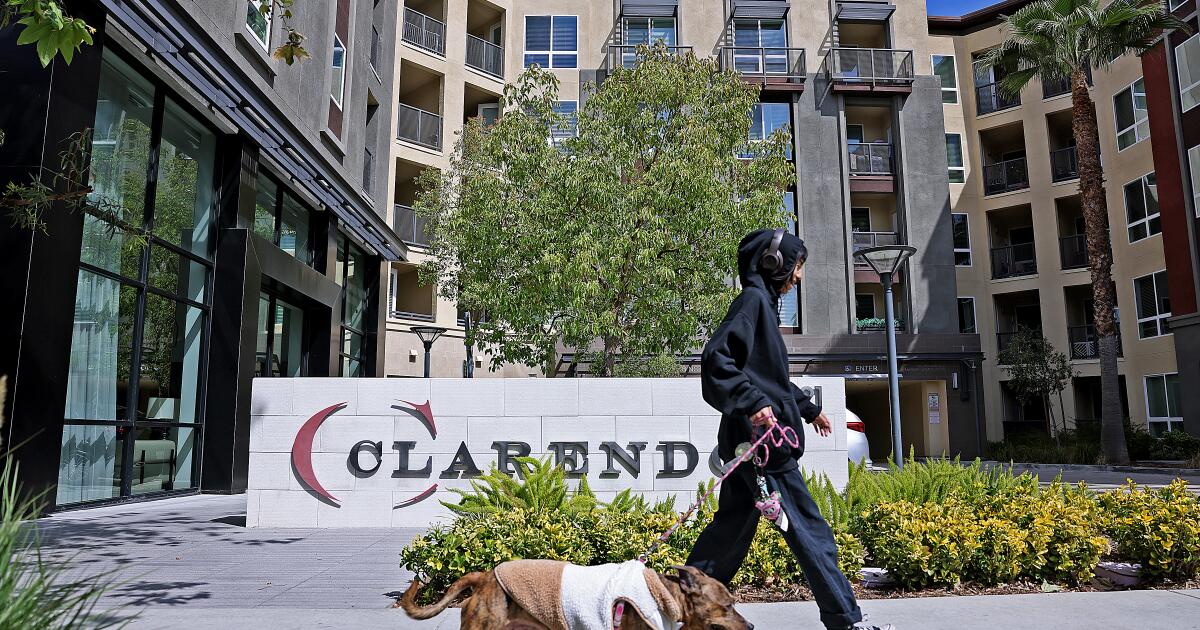
Just off the Topanga Canyon exit of the 101 Freeway sits a prime instance of fashionable, luxurious condo residing.
Built in 2020, the Clarendon Apartments in Woodland Hills characteristic poolside cabanas, a hearth pit terrace and 24-hour neighborhood room with a kitchen and a billiard desk. The residences themselves are spacious — on common two-bedroom items prime 1,000 sq. ft and go for more than $3,000 a month.
Now, a key portion of that is about to change.
In December, the 335-unit complicated was acquired by the Housing Authority of the City of Los Angeles, which is in the course of of turning it into a mixed-income property, while retaining the luxurious facilities.
The authority, which used a distinctive type of financing, sees the acquisition as a mannequin to increase its inexpensive housing portfolio, including in areas like Woodland Hills that are shut to jobs and good colleges.
The neighborhood room at the Clarendon Apartments in Woodland Hills.
“It is really important for us to create housing opportunities and open up access to neighborhoods that are stable,” housing authority Chief Executive Lourdes Castro Ramirez said.
Under the plan for the Clarendon, about a third of the items will be reserved for low-income households, outlined as these making 80% or less of the space median earnings. The remaining will be put aside for middle-income households, making up to 150% of the median earnings.
Rent will differ relying on earnings, but for a family of three in the lowest of the low-income department, a two-bedroom will price a most of $936 a month — a few thousand {dollars} under present ranges.
Some middle-income items won’t differ much from the market fee, but the housing authority said total common lease is still expected to be 32% less than what it was under the outdated proprietor.
The native housing authority is finest recognized for proudly owning conventional public housing complexes such as Nickerson Gardens in Watts and for administering the federal Section 8 voucher program, which subsidizes the lease that low-income tenants pay to non-public landlords.
Less recognized is that the authority owns about 150 other rental properties, with a combine of market-rate and inexpensive items, principally bought in the Nineteen Eighties. But last yr, the housing authority put aside $30 million to ramp up acquisitions.


1. A two-bedroom unit at the Clarendon Apartments in Woodland Hills. 2. A two-bedroom unit at the Clarendon Apartments. 3. A one-bedroom unit at the Clarendon Apartments in Woodland Hills.
The first major property acquired using those funds was the $156-million Clarendon Apartments. The agency put in $12.5 million from its $30-million fund as equity and issued tax-exempt bonds that it sold to private investors to cover most of the rest.
Financing for the Clarendon also included a $5-million, low-interest loan from LA4LA, a new organization championed by Mayor Karen Bass that uses philanthropic dollars to fund affordable housing.
In total, about 11% of the financing to acquire the Clarendon came directly from the government and philanthropy, with the rest from private bond investors.
All parties — bond investors, the housing authority and philanthropic funds — expect to earn at least some return on their investment.
Sarah Dusseault, lead strategist for LA4LA, said that by leveraging investment from the nonprofit and private sectors, the Clarendon model enables scarce government dollars to go further and provides an opportunity to meaningfully improve the affordability crisis. Not only can the model support acquisitions, Dusseault argued, it could be used to build affordable housing cheaper and quicker, in part because when compared with today’s government-heavy finance process there are fewer hurdles to raising money in the bond market.
“We can actually have the capital available at the scale we need it,” Dusseault said.
Before the housing authority purchase, the Clarendon set aside 8% of the units for lower-income families, but the agency is greatly expanding the number available and putting some rent restrictions on all units. Annual rent increases for tenants will also be capped at 4%.
Despite that, the housing authority expects to earn about $1 million annually on the property in the first few years, according to an agency report, money that can be used to provide its tenants more services or acquire additional units.
One reason the Clarendon is still expected to produce income is that as a government agency, the housing authority doesn’t need to pay property tax.


1. The pool area at the Clarendon Apartments in Woodland Hills. 2. The wifi room at the Clarendon Apartments. 3. The business center at the Clarendon Apartments.
In that way, the Clarendon acquisition was similar to deals other cities have completed in recent years, in which they partnered with private real estate firms to acquire properties and lower the rent.
The housing authority, however, said its model has the potential to produce more affordability than those deals, because unlike private firms, the agency doesn’t charge fees and it has access to a certain type of funding from the federal government that only housing agencies do.
For example, the housing authority is receiving money from the Department of Housing and Urban Development that will subsidize rent for many of the property’s tenants that make very low or extremely low incomes.
In all, there will be 24 units reserved for households making 30% or less of the area median income and an additional 42 for those making 50% or less of the median income — levels of affordability not achieved in most of the deals cities did with private partners.
The housing authority hopes the Clarendon isn’t a one-off and is exploring ways to find more money for acquisitions.

The fitness center at the Clarendon Apartments.
At the moment, the agency said, all tenants are left over from the previous owner and can stay as long as they want. When they move out, they will be replaced by low- and middle-income residents who will pay rent deemed affordable based on their incomes.
Out of the 335 units at the Clarendon, the vast majority are one and two bedrooms, which the housing authority says are most in demand for lower-income households.
Unlike most buildings where low-income families live, tenants will have all the bells and whistles: new appliances, “smart” HVAC systems, a community business center and poolside cabanas under palm trees.
“This is,” Castro Ramirez said, “a wonderful building.”
Source hyperlink