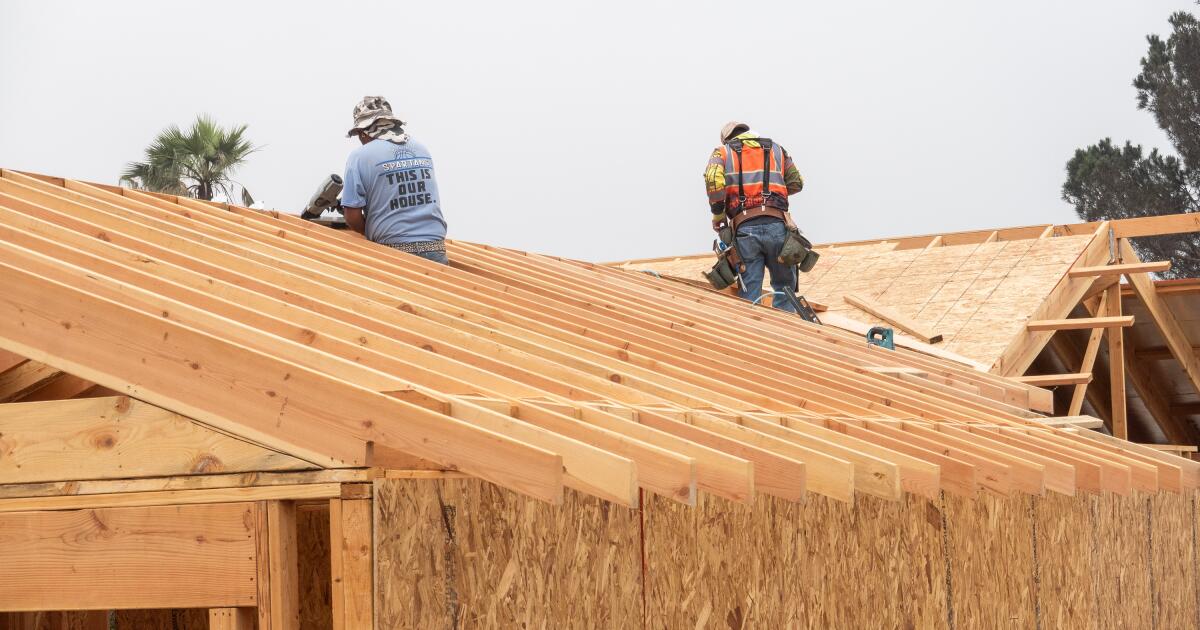
When ICE brokers raided the building website of a burned property in Altadena this month, they made no arrests. The man they were after was not there. But the mere specter of them returning spooked the staff enough to carry the undertaking to a momentary halt.
The next day, half of the 12-man team stayed home. The crew returned to full energy by the finish of the week, but they now work in concern, according to Brock Harris, a actual property agent representing the developer of the property.
“It had a chilling effect,” he said. “They’re instilling fear in the workers trying to rebuild L.A.”
Harris said another developer in the space began camouflaging his building websites: hiding Porta Potties, eradicating building fences and having staff park far-off and carpool to the website so as not to entice consideration.
The potential of widespread immigration raids at building websites looms ominously over Los Angeles County’s prospects of rebuilding after the two most damaging fires in its historical past.
A new report by the UCLA Anderson Forecast said that roundups could hamstring the colossal endeavor to reconstruct the 13,000 houses that were wiped away in Altadena and Pacific Palisades on Jan. 7 — and exacerbate the housing disaster by stymieing new building statewide.
“Deportations will deplete the construction workforce,” the report said. “The loss of workers installing drywall, flooring, roofing and the like will directly diminish the level of production.”
A home under building in Altadena.
(Myung J. Chun / Los Angeles Times)
The penalties will unfold far beyond these who are deported, the report said. Many of the undocumented staff who handle to keep away from Immigration and Customs Enforcement will be pressured to withdraw from the labor power. Their specialties are usually essential to getting tasks accomplished, doubtlessly harming the fortunes of remaining staff who can’t end jobs with out their assist.
“The productive activities of the undocumented and the rest of the labor force are often complementary,” the report said. “For example, home building could be delayed because of a reduction in specific skills” ensuing in “a consequent increase in unemployment for the remaining workforce.”
Jerry Nickelsburg, the director of the Anderson Forecast and writer of the quarterly California report launched Wednesday, said the “confusion and uncertainty” about the rollout of both immigration and commerce insurance policies “has a negative economic impact on California.”
Contractors need to rent Americans but have a laborious time discovering enough of them with correct skills, said Brian Turmail, a spokesperson for the Associated General Contractors of America commerce group.
“Most of them are kind of in the Lee Greenwood crowd,” he said, referring to a nation music singer identified for performing patriotic songs. “They’d rather be hiring young men and women from the United States. They’re just not there.”
“Construction firms don’t start off with a business plan of, ‘Let’s hire undocumented workers,’” Turmail said. “They start with a business plan of, ‘Let’s find qualified people.’ It’s been relatively easy for undocumented workers to get into the country, so let’s not be surprised there are undocumented workers working in, among other things, industries in construction.”
The commerce group said authorities insurance policies are partly to blame for the labor scarcity. About 80% of federal funds spent on workforce improvement go to encouraging college students to pursue four-year levels, even though fewer than 40% of Americans full school, Turmail said.
“Exposing future workers to fields like construction and teaching them the skills they need is woefully lacking,” he said. “Complicating that, we don’t really offer many lawful pathways for people born outside the United States to come into the country and work in construction.”

A home under building in Altadena, where immigration brokers visited earlier this month.
(Myung J. Chun / Los Angeles Times)
The lately raided Altadena undertaking had a lot of momentum before the raid, Harris said. The unique home burned in the Eaton hearth, but the basis survived, so the developer, who requested anonymity for concern of ICE retribution, bought the lot with plans to rebuild the actual home that was there.
Permits were shortly secured, and the developer hoped to end the home by December. But as immigration raids proceed across L.A. County, that timeline could be in jeopardy.
“It’s insane to me that in the wake of a natural disaster, they’re choosing to create trouble and fear for those rebuilding,” Harris said. “There’s a terrible housing shortage, and they’re throwing a wrench into development plans.”
Los Angeles actual property developer Clare De Briere called raids “fearmongering.”
“It’s the anticipation of the possibility of being taken, even if you are fully legal and you have your papers and everything’s in order,” she said. “It’s an anticipation that you’re going to be taken and harassed because of how you look, and you’re going to lose a day’s work or potentially longer than that.”
De Briere helped oversee Project Recovery, a group of public and non-public actual property specialists who compiled a report in March on what steps can be taken to velocity the revival of the Palisades and Altadena as displaced residents weigh their choices to return to fire-affected neighborhoods.
The prospect of raids and elevated tariffs has elevated uncertainty about how much it will price to rebuild houses and business buildings, she said. “Any time there is unpredictability, the market is going to reflect that by increasing costs.”
The disappearance of undocumented staff stands to exacerbate the labor scarcity that has grown more pronounced in current years as building has been slowed by excessive rates of interest and the rising price of supplies that could get even more costly because of new tariffs.
“In general, costs have risen in the last seven years for all sorts of construction,” including homes and residences, said Devang Shah, a principal at Genesis Builders, a agency centered on rebuilding houses in Altadena for individuals who were displaced by the hearth. “We’re not seeing much construction work going on.”
The slowdown has left a scarcity of staff as many contractors consolidated or got out of the enterprise because they couldn’t discover enough work, Shah said.
“When you start thinking about Altadena and the Palisades,” he said, “limited subcontractors can create headwinds.”
Source hyperlink