
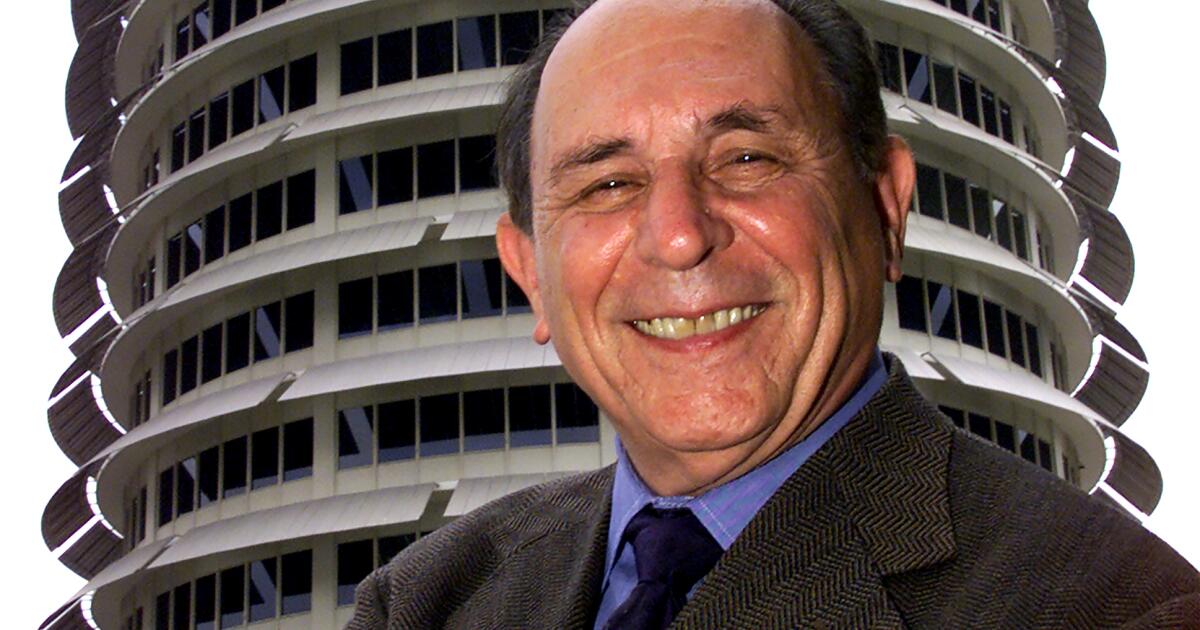
Architect Louis Naidorf had a disastrous eightieth birthday cake. In 2008, Naidorf, who designed the Capitol Data constructing in Hollywood, was introduced with a celebration cake that had been custom-baked within the form of his iconic cylindrical constructing. However the pastry quickly mirrored the fairly substantial distinction between concrete and flour.
“When the cake was brought out, it gently collapsed, and everyone applauded,” Naidorf says, laughing over the cellphone from his home in Santa Rosa. “It was like in one of the movies where the Capitol Records building was destroyed.” Fortunately the cake for his ninety fifth birthday, which he celebrated final month, was extra structurally sound.
Designated a historic-cultural monument in 2006, the constructing has lengthy been a favourite Los Angeles landmark to demolish on movie — particularly for filmmaker Roland Emmerich, who blew it up with an alien spaceship in “Independence Day” and slammed it with twisters in “The Day After Tomorrow.” But no film can ever write the constructing out of a central place in in style music historical past. The tower is synonymous with the illustrious Capitol Data, home of Nat King Cole and Frank Sinatra, and the American document label of Pink Floyd and the Beatles, with the latter’s stars lining the Hollywood Stroll of Fame proper in entrance of the constructing.
Over the past a number of years, the constructing has been illuminated in assist of assorted sociopolitical causes. In 2020, it was lighted pink to assist impartial music venues. Final yr, throughout their efficiency in Hollywood, Duran Duran lighted the Capitol Data constructing blue and yellow in solidarity with Ukraine. “I think that’s excellent,” Naidorf says. “Anything that vigorously engages the public on the right side of good causes transcends other issues. I’m flattered they use the Capitol Records building. It means it has enough cachet to merit being chosen to do that.”
Just like the well-known landmark he designed, Louis Naidorf has of late been experiencing his personal brush with stardom, with postcards from autograph seekers arriving at his door. He’s flattered however doesn’t take the eye too severely.
“It’s obvious that if someone asks me for four signatures I’m part of trading baseball cards or something,” he says. “They are going to trade four Lou Naidorfs for one Joe Smith.”
Nonetheless, he’s stunned and considerably baffled by the sudden burst of recognition in spite of everything these years. “I guess my name ended up on a list or something,” he shrugs.
An aerial drone view of the Capitol Data Constructing in Hollywood and the downtown Los Angeles skyline on Sept. 13, 2023.
(Allen J. Schaben / Los Angeles Occasions)
Naidorf was simply 24 years previous when he designed the Capitol Data constructing, in 1953. It was the world’s first round workplace constructing.
Although it was 70 years in the past, he vividly recollects how he felt when he acquired the task for his first solo mission. “At one level, I felt enormous anxiety that if I didn’t get a solution, very, very quickly, something terrible would happen,” he says. “On the other hand, I felt a total confidence that I could do it. So it was a crazy contradiction.”
Naidorf notes the constructing’s porcelain enamel sunshades with fastidiously spaced gaps to play with mild and shadow. These trigger spiral strains to look on the constructing, drawing the attention right into a rhythm fairly than straight up and down. “You can see Capitol Records from quite a distance and you get a first impression of its basic form and character. You have a reading of it as complete,” he says. “But the building is designed so that the closer you get to the building, you discover more details.”

The Capitol Data constructing’s porcelain enamel sunshades create spiral strains that draw the attention right into a rhythm fairly than straight up and down.
(Allen J. Schaben / Los Angeles Occasions)
What in regards to the long-standing delusion that its spherical form was designed to seem like a stack of information with a rooftop antenna resembling a phonograph needle? As arduous because it is perhaps to consider, the legendary story in regards to the constructing is only a coincidence — an city legend that Naidorf has tried to debunk for many years.
In truth, when his boss, Welton Becket, tasked him with the task, the constructing was merely known as Venture X. Shrouded in secrecy, Naidorf was given little steerage for the mission aside from being requested to design a 13-story constructing on a sloped aspect avenue in Hollywood that needed to be stored as cool as attainable and had smaller than regular flooring house. He additionally didn’t know for whom he was designing it. Naidorf says it was frequent for purchasers’ identities to be stored confidential through the preliminary planning levels of a mission.
Nonetheless, Naidorf relished the inventive latitude. The absence of knowledge left him unburdened by preconceived concepts. “I knew the door was open for something special. It urged me so strongly,” he says earnestly. “I felt, and I think all architects feel this way … there’s a drive to translate the mundane bare requirements that clients come in with into something that has some poetic qualities about it.”
Naidorf then had an epiphany: The mission’s necessities have been “eerily resonant” with a sequence of round buildings he had designed for his grasp’s thesis in faculty. “The round shape is a very efficient enclosure of space,” he says. “You get more bang for your buck.”
Not everybody agreed with his method. Naidorf says that Capitol Data co-founder and President Glenn Wallichs turned irate when Naidorf introduced him with a mannequin and drawings of a spherical constructing, and “violently rejected” the design. “He thought it was a cheap stunt designed by a young guy to make the building look like a stack of records,” Naidorf says, laughing.
Wallichs insisted that Naidorf change the spherical design with plans for an oblong constructing. However when each rectangular and round designs have been introduced to the insurance coverage firm financing the land, Naidorf says that Wallichs was urged to proceed with the spherical design.
Quickly after, when discuss of the constructing housing a radio station (that by no means got here to fruition) was raised, Naidorf fretted when he was requested to design an antenna. He was anxious that it could seem like a phonograph needle and cement the concept that the constructing was designed to seem like a stack of information.
Owing to his nagging concern, Naidorf positioned the rooftop spire asymmetrically, poised to look as if it touches the roof delicately, like “a ballerina en pointe.” He calls it the constructing’s “grace note.” Nonetheless, the stack-of-vinyl delusion persists. Laughing, Naidorf says, “It’s the most enduring myth of all.”
Regardless of his good humor, it leaves him conflicted. “The building was not designed as a cartoon or a giggle. To have it trivialized with the stack-of-records myth is annoying and dismaying,” he says. “There’s not a thing on the building that doesn’t have a solid purpose to it.”
Naidorf’s ingenuity has been particularly spectacular to Los Angeles-based architect Lorcan O’Herlihy, who says he has “often responded strongly to the fact and admired that here was this interesting architect [Naidorf] who was combining science and art, or artistry and technology. Welton Becket [& Associates], very much to their credit, were at a period where modernism was at its heyday and they had to come up with ideas that were new and fresh and they did it, and Lou was certainly instrumental in that. His work is extraordinary.”

Architect Louis Naidorf calls the spire on the Capitol Data constructing’s roof its “grace note.”
(Allen J. Schaben / Los Angeles Occasions)
Naidorf was born in Los Angeles in 1928. His father owned a store the place he made and offered ladies’s clothes, with Naidorf’s mom lining the clothes. Owing to his father’s lack of accounting abilities and enterprise acumen, nonetheless, the enterprise typically collapsed, forcing his mother and father to work at a garment manufacturing facility till money owed might be paid off to reopen the shop.
All through his childhood, Naidorf’s household struggled financially as they moved round, residing largely in Silver Lake and Los Feliz. With solely sufficient cash to lease studio residences, Naidorf’s mother and father slept on a Murphy mattress whereas Naidorf spent his nights on a mattress on the ground.
As just a little boy, Naidorf felt drawn to buildings. When his third-grade instructor embellished the classroom with a Hawaiian trip theme, his fascination morphed right into a calling. “I asked my teacher who made the drawings and she said, ‘Naval architects.’ And then I asked her who draws the plans for houses and she said, ‘Architects.’ She told me to ask my mother to show me the floor plans that were published in the real estate section of the Sunday edition of the newspaper.
“When I saw them, I was a goner,” he swoons. “I now knew what I wanted to do. I wanted to be an architect.”
Naidorf remembers, at age 8, designing a three-bedroom home, utilizing a card desk as a makeshift drafting desk. Quickly after, he started designing small cities. “It wasn’t anything brilliant, but I was learning to draw, learning to scale and learning to think in spatial terms,” he says. When he was 12 years previous, Naidorf bought a part-time job at a bookstore, the place he spent his first two paychecks on structure books, absorbing them till they have been threadbare.
Past literature, Naidorf amassed a rising assortment of architectural supplies (T-square, rectangles, devices for ink drawings), because of his bar mitzvah presents, and determined he was able to get to work. Sanford Kent, a younger architect who had simply graduated from USC, employed a tenacious 13-year-old Naidorf, paying him out of his personal pocket.
Naidorf says tackling the summary issues Kent gave him without delay stimulated his thoughts and have been instrumental in forming his long-standing ethos. “It got me thinking about architecture in terms of its effect on human emotions. The key issue is, ‘How do people respond to your work, whether from a distance or by living it?’” he says.
He continued to take in no matter he may about structure, gearing his junior and highschool lessons towards finding out structure in college. He attended UC Berkeley as a substitute of the privately funded USC, not solely to depart home and broaden his horizons but additionally due to its affordability.
Even nonetheless, Naidorf couldn’t afford the entire program’s required supplies. He borrowed airbrushes from his fellow college students, who would additionally give him their pencil stubs as a substitute of tossing them out. Naidorf submitted his assignments on pebble board, which was not solely cheaper than illustration board however allowed him to attract on one aspect, flip it over and draw on the opposite.
In 1950, Naidorf graduated on the high of his class and bought his grasp of structure diploma a yr early. He skipped his commencement ceremony as a result of he had a job interview the subsequent day at Welton Becket & Associates, the place he was promptly employed. Amongst his earliest design assignments: a tray slide for a hospital cafeteria, a garments closet and a “Please Wait to Be Seated” signal for a restaurant.
Three years into his employment, he started engaged on the Capitol Data constructing. Naidorf says he would design it the very same method if he got the task in the present day.

Andrew Slater, former Capitol Data president and chief government, says, “When you go to work every day in that building it’s like you’re going into a piece of art.”
(Allen J. Schaben / Los Angeles Occasions)
Andrew Slater, former Capitol Data president and chief government (2001-07), attests to the constructing’s distinctive appeal. “When you go to work every day in that building it’s like you’re going into a piece of art, and it informs your attitude … to do something with that mindset, which is great,” he says. “Even though working in the music industry is, in a sense, an industrial endeavor, you never felt like you were doing anything industrial when you walked into that building.”
Nonetheless, Naidorf fears being perceived as a “Johnny One Note,” as he places it. Noting the plaque bearing his identify outdoors the constructing’s major entrance, he expresses gratitude however wariness “that this one modest project has to carry my whole reputation on it.”
It’s a good level, given the magnitude of Naidorf’s notable oeuvre. It’s earned him 17 regional honor and advantage awards and AIA California’s Lifetime Achievement Award (2009). His work additionally has been featured on the J. Paul Getty Museum in Los Angeles.
“I know Capitol Records is always the first one people talk about and it’s a splendid, iconic building that fuses artistry and functionalism, but he’s also produced other projects over the years,” says fellow architect O’Herlihy. “The Santa Monica Civic Auditorium is brilliant.”

An early {photograph} of the Santa Monica Civic Auditorium, designed by Louis Naidorf.
(Christina Home / Los Angeles Occasions)

An early {photograph} taken contained in the Santa Monica Civic Auditorium.
(Christina Home / Los Angeles Occasions)
Naidorf designed the three,000-seat capability Santa Monica Civic Auditorium on the heels of the Capitol Data constructing, within the late Fifties. Basically two buildings in a single, it was a problem to design a locale that functioned without delay as a efficiency house with a sloped flooring and an exhibit corridor with a flat flooring for sports activities occasions, banquets and commerce exhibits.
He reworked the ground from flat to tilted utilizing a hydraulic system that was hailed for its innovation. “I don’t think you’ll find any place that has a symphony on a Friday night and a gem show, or some kind of hobby show, on Saturday,” he says.
Previously home to the Santa Monica Symphony Orchestra however at the moment sitting vacant, the Civic Auditorium opened its doorways to the general public in 1958. From 1961 to 1968, it hosted the Academy Awards. It additionally was the location of reside recordings together with George Carlin’s comedy document “Class Clown” and the Eagles’ “Eagles Live,” a double LP recorded throughout their three-night run on the venue. It additionally hosted “The T.A.M.I. Show” in 1964.
Within the meantime, whereas the Civic was nonetheless beneath development, Naidorf designed the 15,000-seat capability Los Angeles Memorial Sports activities Enviornment, the most important enviornment in Los Angeles when it opened in 1959. (The sector was demolished in 2016 to make method for the Banc of California Stadium, now referred to as BMO Stadium.)

The Los Angeles Memorial Sports activities Enviornment, one other Naidorf design, on Might 26, 1960.
(Los Angeles Occasions)
Naidorf says the Sports activities Enviornment, home to varied Los Angeles sports activities groups together with the NBA’s Lakers (1960-67) and Clippers (1984-1999) and the NHL’s Kings (1967-68), was constructed to draw sports activities groups to Los Angeles, however uncertainty about whether or not they’d catch on meant the power needed to be viable for different functions.
In 1960, a yr after it opened its doorways, the Sports activities Enviornment hosted the primary Democratic Nationwide Conference in Los Angeles, the place John F. Kennedy turned the presidential nominee. Muhammad Ali (then referred to as Cassius Clay) gained a boxing match there in 1962. It additionally hosted rallies by Martin Luther King Jr. and the Dalai Lama, and noticed concert events by legendary rock acts together with the Grateful Lifeless.
Bruce Springsteen performed the venue’s closing concert events earlier than the constructing was demolished, a three-night stint throughout which he devoted his tune “Wrecking Ball” to the constructing lovingly nicknamed “The Dump That Still Jumps.” “Well, it was pretty dumpy by the end,” Naidorf says, laughing. “Not all architecture is permanent,” he continues. “I’d rather it was demolished and some useful purpose made of the site than having it sit there old, shabby and neglected as it was.”
Naidorf’s credit additionally embody the Beverly Hilton Lodge, the Beverly Middle and the Reagan State Workplace Constructing downtown. Outdoors of Los Angeles, Naidorf helmed the restoration of the California State Capitol Constructing in Sacramento, a six-year enterprise after which the largest-ever restoration undertaken within the U.S., and he designed President Gerald Ford’s home in Rancho Mirage.
The tallest constructing in Arizona, the Valley Nationwide Financial institution constructing (now Chase Tower) in Phoenix, additionally was designed by Naidorf, in addition to the Hyatt Regency Dallas and adjoining Reunion Tower, essentially the most recognizable landmark of the town’s skyline.

The California State Capitol Constructing in Sacramento in 2014.
(Francine Orr / Los Angeles Occasions)
He particulars these and his different high-profile initiatives in his 2018 e-book “More Humane: An Architectural Memoir”, stuffed with images, backstories and private anecdotes. Flipping by its pages, one learns that Naidorf not solely took dangers designing his initiatives however even risked his job occasionally.
He writes in his memoir that in 1958, when he was designing the Humble Oil (now Exxon) headquarters in Houston, he refused to design separate locker rooms and consuming fountains for Black and white individuals, as the corporate requested him to. When he went home on that Friday evening, he describes not understanding if he’d have a job the next Monday. Not solely did Naidorf not lose his job, he says, however the firm ceased segregating its locker rooms and consuming fountains after that.
“I realized architects have access to some of the most powerful people in the world and it is our job to bring up issues that represent social issues rather than just architectural design,” he says. “The only thing for evil to triumph is for good people to remain silent. Architects should not remain silent.”
Naidorf additionally understood that generally he was designing initiatives the place individuals don’t wish to be, just like the Naval Medical Middle in San Diego, which opened in 1988. “I felt that there were two emotions we had to contend with,” he says. “One was to lay the sense that this would be welcoming and have a more personal quality. But if you go to a hospital you want a quite contradictory thing. You want to have a sense that it’s state-of-the-art, that whatever powerful forces can cure you, they’re there.”
As an alternative of 1 medical constructing, which he felt would appear ominous, he designed a number of constructions and a sequence of out of doors walkways to make the power really feel heat and comforting. The remedy and diagnostic a part of the power was daring, with an abundance of metal and glass. Walkways have been lined with floor-to-ceiling glass to permit sufferers to see the out of doors courtyard, grass, bushes, sky and distant views of a golf course “based on the primitive feeling you have in the hospital, which is to get out of the damn place,” he says.
When he was out buying a number of months in the past, Naidorf met a lady who talked about that she had been within the Navy, forcing her to maneuver round loads when her son was battling childhood leukemia. With out understanding she was speaking to the Naval Medical Middle’s designer himself, she instructed Naidorf that it was the one hospital that didn’t scare her sick 6-year-old son, who has since made a full restoration.
“What kind of an architect…,” Naidorf says, overcome with emotion and his voice breaking, “do you have to be not to hold that as better than any design award?”
Although Naidorf had risen by Welton Becket & Associates’ ranks to grow to be vp, director of analysis and director of design, he grew more and more sad after the agency’s merger with Ellerbe Associates (it was renamed Ellerbe Becket). He moved into academia full-time in 1990, spending simply at some point per week on the agency.
Naidorf turned dean of the College of Structure and Design at Woodbury College, incomes quite a few distinctions, together with instructor, school member and administrator of the yr. He was additionally a visitor professor at UCLA, USC, Cal Poly Pomona and SCI-Arc. At his retirement ceremony in 2000, he was awarded an honorary doctorate, marking not solely the tip of his educational profession but additionally his time in Los Angeles.

The Alumni Quad at Woodbury College in Burbank in 2018.
(Raul Roa / Los Angeles Occasions)
Charmed by the great thing about Northern California, Naidorf moved up the coast to Santa Rosa. For the subsequent 15 years, he continued working with Woodbury College as campus architect, designing and reworking a few of its buildings, and was invited to be a board member.
When he parted methods with Woodbury at 87 years previous, it was not with the aim of taking it straightforward. Naidorf had different pursuits in thoughts, together with his work with Metropolis Imaginative and prescient Santa Rosa revitalizing the town’s downtown space.
He additionally helped his shut buddy, Mike Harkins (who edited Naidorf’s memoir), design his new home freed from cost after the 2017 Tubbs Hearth burned Harkins’ home to the bottom and he and his spouse misplaced 99% of their belongings.
“Lou offered without solicitation: ‘I’d like to design your house,’” Harkins says. “To me or anyone else who knows him, it was a heartfelt offer that of course he would make, and yet so much more. One analogy might be if Eric Clapton said, ‘I’d like to play at your wedding.’ The knowledge and sensibility that comes along with a Naidorf design offering is huge, just like his heart.”
Most not too long ago, Naidorf has been experimenting with plans for a mission to assist people who find themselves unhoused.
Naidorf has made essentially the most of his structure license over the past 71 years. His voice fills with satisfaction when he reveals that he holds the earliest issued lively structure license within the state of California, obtained in 1952.
“It’s something I wanted to be since I was a little kid. My architecture license was so hard to come by. I don’t want to give it up,” he says with palpable emotion. “I don’t want to be retired. I want to be an architect until I fall over. I plan to be buried as a licensed architect.”

Louis Naidorf, pictured when he was dean of the College of Structure at Woodbury College in Burbank, in his workplace.
(Ann Johansson / For The Occasions)
Of not too long ago turning 95, he jokes that he seems like a nasty vaudeville performer who quickly might be pulled offstage by a hook. However Naidorf stays in remarkably good well being after surviving each prostate and esophageal most cancers in his 80s.
To maintain his mind sharp, he does workout routines together with counting backward from 100 by sevens and taking IQ checks on-line.
As a nonagenarian, he says there isn’t a key to residing an extended life. He suggests, although, that it helps to attempt to use it effectively. “It’s not how big the steak is but how tasty it is,” he says. “I think you have to seek a calling, listen for it and search for it. Find something in your life that is really yours. … Get engaged with something that’s going to scare you, something where the problems are hard. And take risks. There is no failure.”
He additionally notes the significance of adaptability. “I have had four marriages. I’d better be resilient,” he quips. Twice divorced and twice widowed, Naidorf has a daughter from his first marriage, 4 stepchildren (who name him “Dad”) from his fourth marriage, 11 grandchildren and 6 great-grandchildren. An intensely personal man, he’s reticent to talk publicly about his relationships and household, preferring to deal with his work.
“I remain so fascinated with architecture,” he says. “I cannot even walk past a store where somebody is putting in an electrical outlet without stopping to look in and watch it.”
The chatty Naidorf turns summarily succinct, saying, “I certainly have had a good run.”
Supply hyperlink


